Testimonials
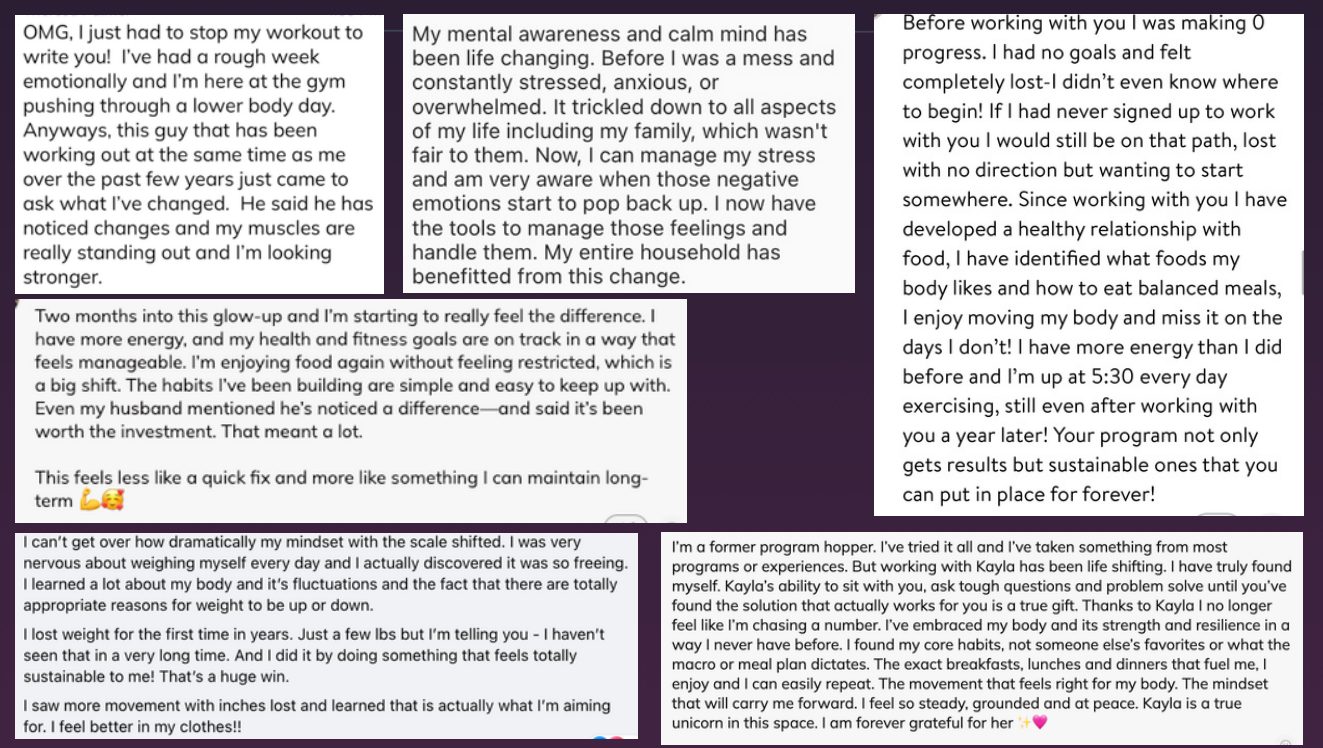
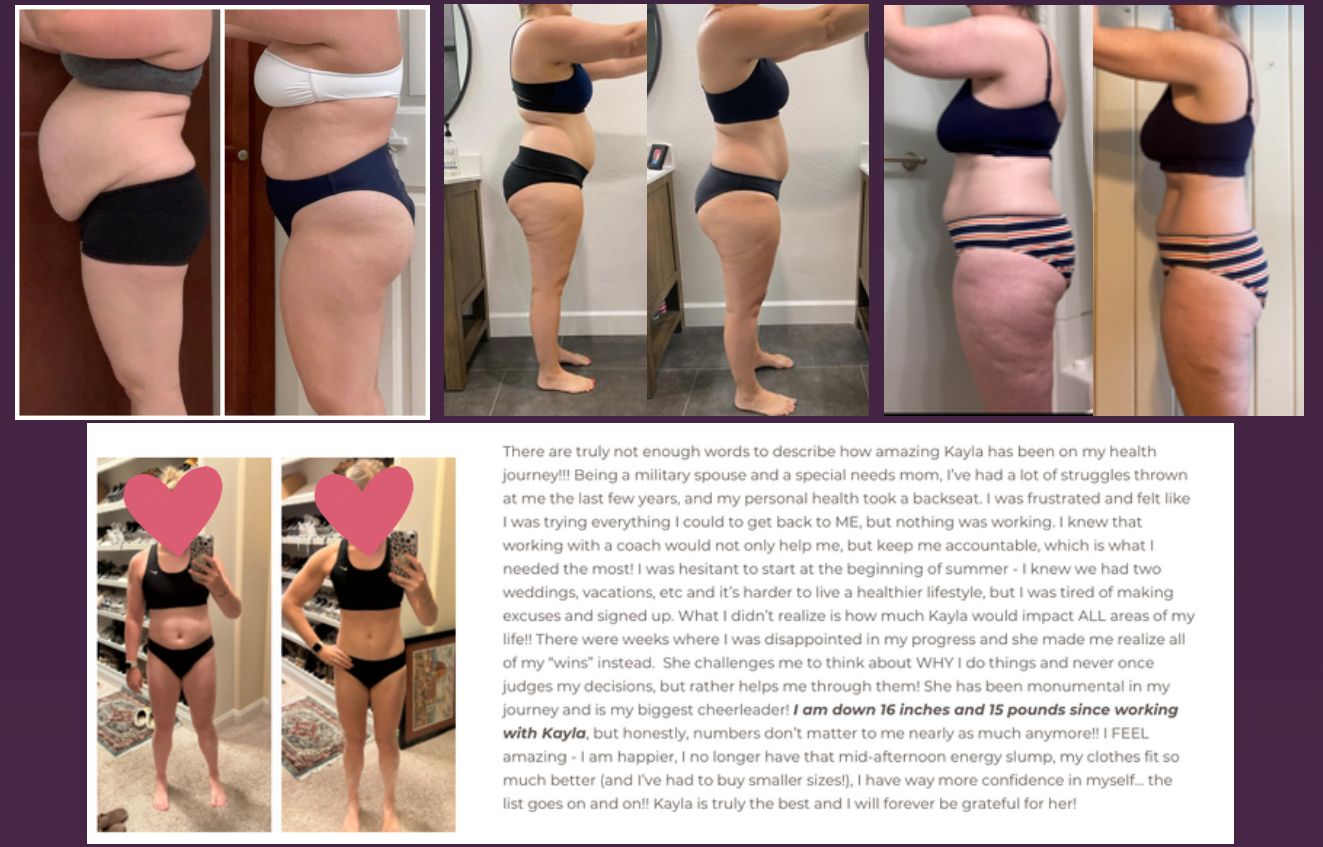
The Glow Up in real life
A 10-module identity-first framework for high-achieving moms who are done with the restart cycle and ready to become the woman they deep down KNOW they're meant to be in a body they absolutely LOVE being naked in.
If you came from the Baddie Body Blueprint, you already know what the problem is. You know your archetype. You know the gap. This is where we close it.
If you are starting here without the Blueprint, no worries. Everything you need is inside. But know this going in:
Everything you type in this playbook saves automatically on this device.
Grab the printable version.
"The cycle does not stop when you find the right plan. It stops when you close the gap."Kayla Torres
Your actual life. Not a perfect version of it.
The critical foundations. These are what make everything else work.
Protein protects your muscle while you are in a fat loss phase, keeps you fuller longer, and supports your metabolism. Without it, you are just losing weight, not building the body you actually want.
Fiber keeps you fuller longer, supports digestion, regulates blood sugar, and reduces the cravings that lead to the pantry raid at 9pm.
A naked carb is a carbohydrate eaten alone: no protein, no fat, no fiber alongside it. Think crackers by themselves, a piece of bread as a snack, cereal with skim milk, a handful of fruit with nothing else. It's not that carbs are the enemy, but eating them without a buffer is a setup.
Here's why it matters: carbohydrates break down quickly into glucose. When you eat them alone, that glucose hits your bloodstream fast, your blood sugar spikes, your body pumps out insulin to manage it, and then it crashes. That crash is what triggers the 3pm slump, the sudden hunger an hour after you ate, and the craving for something sweet even when you just had a full meal. Your blood sugar is running the show instead of you.
When you pair carbs with protein, fat, or fiber, you slow that process down. The glucose releases more gradually, meaning your blood sugar and energy stay stable. Your hunger cues stay clear instead of chaotic, and you feel satisfied longer and make food decisions from a regulated place instead of a reactive one.
This doesn't have to be complicated:
Skipping meals is not a strategy. It is a setup for making worse decisions later when hunger has been ignored for six hours and willpower is depleted.
Eating too little slows your metabolism, tanks your energy, accelerates muscle loss, and makes your body hold onto fat as a protective response. More restriction is not a shortcut. It's usually what's causing the stall.
High sugar intake spikes blood sugar, increases fat storage (especially visceral fat), worsens insulin sensitivity, and keeps cravings running the show instead of you.
It is not a discipline problem or a knowledge problem.
It's the identity gap: you set goals from the aspirational version of you and execute from the current version. The friction between them creates shame. Shame resets the cycle.
Every time you have started over, that was not failure. That was proof the gap was still there. The cycle does not stop when you find the right plan. It stops when you close the gap.
"If it is not 100% it is not worth it."
"I will start back up when I am ready."
"Everyone else comes first. That is just how it is."
Most women are a mix. Check yours.
Now that you know why, here is what to do about it. Starting today.
Before you start a new nutrition plan or workout routine, we need to start here.
This isn't about what you should be doing. You already know that. This is about getting honest about who is actually running the show right now, because the thoughts you carry about your body, your food, your energy, your worth... those aren't just feelings. They're running your habits whether you realize it or not.
The woman who keeps starting over isn't starting over because she lacks discipline. She's starting over because she's still operating from an identity that doesn't match the life she's trying to build.
This exercise is where that changes.
You're going to dump out what's currently there. All of it. No filter, no judgment. And then you're going to introduce HER, the Healthy, Empowered, Resilient version of you who already exists, and start writing from her instead.
The goal isn't to shame where you are. It's to finally see it clearly so you can actually move past it.
No filter. No judgment. Just honest.
Answer each question below. Write the first thing that comes up. This is just for you.
Take everything you just wrote and bring it to your Identity Map.
Write 5 sentences. Present tense. As if she already exists.
You are not writing who you want to become someday. You are writing who you are deciding to be starting now. The language matters. "I want to be" keeps her in the future. "I am" puts her in the room with you.
This is not affirmation culture. It is identity architecture. The brain responds to repetition and specificity: the more clearly and consistently you define who you are, the more your behavior follows. This is the mechanism. Use it.
"I am the woman who shows up even when it is inconvenient..."
"I do not wait to feel like it. I move and the feeling follows..."
"I take care of my body because of who I am, not because of how I look..."
Save this. You will use it in Module 10. Screenshot it and tag @BaddieBodybyKayla. I want to see who you are becoming.
Not what she feels like... what she DOES.
Non-scale wins often show up before the scale moves. Learn to see them.
Why it happens: Life gets full, appetite drops, protein is the first thing to go.
Why it matters: Muscle loss, slower metabolism, fatigue, hair thinning, cravings that feel uncontrollable by evening.
What to do instead:Why it happens: We were taught more movement equals faster results.
Why it matters: Excessive cardio while under-eating increases cortisol, accelerates muscle loss, and stalls fat loss. The opposite of what you want.
What to do instead:Why it happens: We treat stress like a personality trait instead of a physiological state that directly affects fat loss.
Why it matters: A dysregulated nervous system keeps cortisol elevated, disrupts sleep, increases cravings, and signals your body to hold onto fat, especially around the midsection.
What to do instead:Why it happens: Convenience wins when capacity is low.
Why it matters: Ultra-processed foods spike blood sugar, drive cravings, and disconnect you from your hunger and fullness signals. Food decisions come from reaction instead of intention.
What to do instead:Why it happens: We set goals based on our best-day version of ourselves and try to execute them inside our actual lives.
Why it matters: The gap between what you expect and what is actually realistic creates shame, and shame creates the "screw it" spiral faster than anything else.
What to do instead:Why it happens: Slow weeks, plateaus, comparison to other people's timelines.
Why it matters: Results work in phases, not straight lines. Stopping early means missing the compounding effect of consistent behavior over time.
What to do instead:As your body loses weight, its energy needs decrease. A lighter body burns fewer calories. This is not failure. This is biology.
Instead of restricting harder or panicking:
NEAT = Non-Exercise Activity Thermogenesis. The movement you do not think about: walking pace, standing vs. sitting, how much you move through your day. When calories drop, your body unconsciously reduces this to conserve energy.
What to do:
When calorie intake drops too low for too long, your body responds by increasing cortisol, slowing thyroid conversion (T4 to T3), reducing metabolic rate, and contributing to fatigue and hair thinning. More restriction does not equal faster results (especially not in perimenopause, under high stress, or when you're not sleeping well). It usually reverses them.
What to do:
Perimenopause and hormonal changes affect fat storage, water retention, appetite, sleep, and mood. Normal shifts can look like the plan is not working when it actually is. Your body is just navigating something most programs never account for.
What to do:
If the answer to most of those is no, that's your answer.
The plan isn't broken.
The execution needs attention.
Muscle loss is one of the most overlooked risks during fat loss, especially when nutrition isn't dialed in. If protein is low and resistance training is absent, you lose muscle alongside fat. That slows metabolism, reduces strength, affects bone density, and makes results harder to maintain long-term.
Here are the four levers you can adjust to protect your muscle:
Protein is the building material. Without it, the body has nothing to preserve or build with.
Light weights done the same way every week stop producing results. Your body adapts quickly. Progress by:
The message to your body: this muscle is needed. Keep it.
When time is limited, prioritize movements that use multiple muscle groups: squats, deadlifts, lunges, rows, presses. These stimulate more muscle fiber, improve insulin sensitivity, and create a stronger metabolic effect per minute of training.
2 to 4 sessions per week. 30 to 45 minutes. Done beats perfect.
Training hard and eating too little is not a shortcut. It is a fast track to muscle loss, fatigue, and a metabolism that works against you long-term.
Fuel the work. The results follow.
The Success Formula covered your nutritional foundations. This module is where we get practical and personal, because knowing what to eat is not the same as actually eating it inside a real life with a real schedule and real chaos.
Most women who come to me aren't eating too much, they're eating too little. Especially the high-achieving ones running on cortisol, caffeine, and the vague sense that they should probably eat something. Under-eating feels like discipline. It's not. It's a stress response that tanks your metabolism, accelerates muscle loss, spikes cravings by evening, and leaves your body holding onto fat as a survival mechanism. More restriction is not a faster path. It's usually the thing creating the stall.
If you've been stuck in a pattern of restricting during the day and losing control at night, that's not a willpower problem. That's a biology problem. The fix is to eat enough, consistently, during the day so your body isn't in emergency mode by 8pm.
You don't need to track macros to start eating like HER. You need a framework you can actually use at 6pm on a Tuesday when you have 20 minutes and three people who need something from you.
A palm-sized portion. Chicken, fish, eggs, Greek yogurt, ground turkey, cottage cheese.
Half your plate. Vegetables, fruit, legumes, a whole grain if you want one.
A thumb-sized portion. Olive oil, avocado, nuts, cheese.
A naked carb eaten without protein, fat, or fiber spikes blood sugar, triggers insulin, and sets off the crash-and-crave cycle within an hour. Put something alongside it every time.
Hunger is a terrible decision-maker. By the time you're starving, you've already lost the negotiation. The goal isn't to never be hungry, it's to never be so hungry that your brain stops asking what you actually want and starts just looking for whatever will stop the feeling fastest.
Eat within 60 to 90 minutes of waking. Eat consistently through the day. Don't skip meals to "save calories." You will spend them, plus interest, later. Three to five eating windows per day keeps blood sugar stable, keeps energy stable, and keeps you making food decisions from a clear-headed place instead of a depleted one.
Some days the plan goes out the window. Life is full, capacity is zero, and getting a home-cooked meal on the table isn't happening. That's real. Here's what HER does on those days:
The goal is nourishment, not perfection.
These are not emergencies. They're just context that requires a slightly different execution.
At a restaurant: look for the protein first, build the plate around it. You don't have to order the sad salad. You have to make sure something with protein is on the table.
At a party or event: eat before you go if you know the options will be limited. Have a protein source first. Enjoy the food without performing discipline for an audience.
Traveling: pack protein. Quest bars, jerky, individual packets of nut butter, individual Greek yogurts if you have a cooler. And there are options to be found at airports and gas stations.
A week that went sideways: it happened. It doesn't reset the clock. Recommit at the next meal, not Monday. The plan was never that fragile.
Use this in-depth, highly customizable meal planning prompt to stop guessing and start eating like HER.
Get the promptCardio burns calories while you're doing it. Strength training builds the engine that burns calories all day. Muscle is metabolically active tissue: the more you have, the more your body burns at rest, even when you're not in the gym. During fat loss especially, strength training sends the signal that keeps your body from breaking down muscle for fuel. Without it, you're not just losing fat. You're losing the infrastructure that makes fat loss sustainable.
This is not optional. Two to three sessions per week is the minimum. Four is better. Thirty minutes is enough to matter.
Cardio is support, not the main event. It's not punishment for eating. It's not what you add on top of strength training to burn more. It's movement that supports your cardiovascular health, manages stress, improves mood, and keeps daily energy expenditure up without hammering your recovery.
Zone 2 cardio, the kind where you can hold a conversation and your heart rate is elevated but you're not gasping, is the most effective and most underused tool in most women's programs. Walking qualifies. A bike ride qualifies. A slow jog qualifies. You don't have to suffer for it to count.
Two to three sessions per week, 30 to 45 minutes. If stress is high and recovery is low, back off the HIIT and walk instead. A stressed body does not need more stress.
Here's what actually moves the needle, stripped down to its most essential form:
That's it. Everything beyond that is addition. If you're not doing this consistently yet, this is the target. Not the five-day split, not the hour-long sessions, not the perfectly periodized program. Get consistent with the minimum, then build.
There is no such thing as a workout that's too short to count. There is only the workout you did and the one you skipped.
45 minutes, all your working sets, full warm-up and cool-down. This is the goal.
20 minutes, 3 compound movements, whatever weight you can manage. This is still a win.
10 minutes of bodyweight movements in your living room. It still sends the signal. It still counts.
Your body adapts to the stress you give it. The same weights, the same reps, the same workout every week will stop producing results because your body has already adjusted to handle it. Progressive overload is just the practice of giving your body a slightly greater challenge over time so it keeps adapting, which means it keeps changing.
You don't need a complicated program. You need to track your weights and add challenge when what you're doing starts to feel easy.
Progress looks like:
Track every session. You will not remember what you lifted last Tuesday. The data is the accountability.
You don't restart. You re-enter.
The re-entry plan: pick up where you left off, drop the weight slightly if needed, and do not attempt to make up for lost time with a brutal session. Crushing a workout to make up for a missed week doesn't accelerate results. It accelerates soreness, fatigue, and the likelihood you'll avoid the gym for another week.
One session back is the whole goal. Not a perfect session. Not a punishing one. Just back in.
A missed workout is a detour. Deciding it means you've failed is a dead end. HER knows the difference.
Habits collapse without identity underneath them. You've probably experienced this firsthand. You had a solid plan, you were executing, and then one hard week happened and everything fell apart. That's not a discipline failure. That's what happens when behavior is held together by motivation instead of identity.
Every behavior you perform is either consistent or inconsistent with your sense of who you are. When a habit is tied to identity ("I'm the kind of woman who moves her body"), skipping feels like a violation of self. When a habit is just a thing you're trying to do, skipping feels like relief.
Most programs try to change behavior without touching identity. That's why they work for three weeks and fall apart in week four. The behavior was never rooted in anything that holds when it gets hard. Identity work isn't soft. It's the most practical thing in this entire playbook.
She doesn't wait to feel like it. Motivation is the result of action, not the requirement for it. HER does the thing and lets the feeling follow. She's moved her body on days she was exhausted, eaten the protein when takeout sounded better, showed up for a workout she didn't want to do. Not because she felt inspired, but because that's who she is. The feeling of being her follows the choice to act like her.
Done on a hard day beats perfect on an easy one. Always. A B+ effort inside a real week is worth infinitely more than an A+ plan that exists only on paper. HER doesn't raise the bar when life gets full. She finds the floor, the smallest version of her non-negotiables she can hold, and she holds it. That's not settling. That's sustainable.
"What's the smallest version of this I can do today and still count it?"
That question will save you more times than any program ever will. On the days when everything feels hard, when capacity is at zero, when the last thing you want to do is anything, the minimum standard is what keeps you in the game.
Your minimum standard isn't failure. It's protection. It's the gap between a hard week and a spiral. A woman who does the minimum on her worst days is a woman who doesn't have to restart on Monday. That's the whole point.
Monday is a lie your brain tells you when it wants permission to stop trying until conditions improve. Conditions will not improve. Monday will become next Monday. This is the pattern.
The mid-week recovery looks like this: something goes off. A meal, a workout, a day that went completely sideways. Instead of writing off the rest of the week, you ask one question: what's the smallest thing I can do right now to stay in motion?
That's it. Not a plan overhaul. Not a reset. Not a recommitment speech. Just the next smallest action. One glass of water. One high-protein meal. A 15-minute walk. Something that says to your nervous system: we're still in this.
The week isn't ruined. It's just had a detour. HER knows the difference between a detour and a dead end, and she never treats one like the other.
You cannot make aligned decisions from a dysregulated state. This is not motivational language. It's neuroscience. When your nervous system is in threat mode, your prefrontal cortex (the part responsible for long-term thinking, identity-based decision-making, and impulse regulation) goes offline. The part of your brain that says "what would HER do right now?" can't answer when the part of your brain that just wants to survive the moment is running the show.
Regulate first. Then decide.
This looks like: a few slow breaths before you open the pantry. A short walk before you respond to the stressful email. A body scan or quick somatic reset before you make a food decision from exhaustion. You don't have to spend 20 minutes meditating. You just have to create a gap between the feeling and the choice.
A regulated nervous system makes better decisions. A regulated body is a more responsive body. Regulation isn't extra. It's the foundation.
Here's what's actually happening when you know what to do and still don't do it:
When you're stressed, tired, overwhelmed, or running on empty, your brain defaults to the limbic system: the part that runs on emotion, habit, and survival. It's reactive. It's not strategic. It responds to how you feel right now, not who you're trying to become. It's the part that says "screw it, I'll start Monday" before you've even finished the thought.
The prefrontal cortex is the part that makes intentional decisions, thinks long-term, and leads from identity. It's the part that asks "what would HER do right now?" and actually waits for the answer.
Because asking yourself "is my limbic brain running the show right now?" sounds weird, I call this the Bratty voice.
She is not a character flaw. She is just the current version of you that has not closed the gap yet.
She made a decision about who she is and she leads from that, even when it is hard.
You do not have to be the Baddie 100% of the time.
You just have to catch the Brat before she makes the decision for you.
Identity without action is just journaling. This is seven days of exactly what to do so you leave this week knowing you can actually follow through. Not a detox. Not a reset. Seven days of living like HER on purpose, with a plan, even when life gets messy.
Today is about setting yourself up so you're not making decisions from a depleted state.
The goal isn't perfect execution. The goal is catching yourself and choosing differently once.
Today, you practice your minimum standard day. What does showing up look like when you have 20 minutes, low energy, and a full schedule?
That's it. That's a win.
Each day, repeat this rhythm:
Do not restart. Do not wait for Monday.
Ask: "What's the smallest thing I can do right now to stay in motion?" That's your next action.
The goal isn't perfect execution. The goal is catching yourself and choosing differently. One catch per day is enough to start.
That last question is your bridge.
Fill in your sections and keep this somewhere you will actually see it.
Before you act: is this the Baddie or the Brat making the call?
If it is the Brat, what is the smallest Baddie move I can make right now?
"What would HER do right now?"
You just did something most women never do. You stopped diagnosing the problem and started doing something about it.
You have a named pattern. A future HER identity. HER non-negotiables. A decision filter. Nutritional foundations. A muscle protection plan. Seven days of proof that you can follow through. That's not nothing, that's the foundation.
What this playbook can't give you is the full container: the coaching, the accountability, the community, and the complete system to run this inside your actual life for 24 weeks.
That's what H.E.R. Glow Up is.
24 weeks. The full system. Results that hold when life gets messy.
Apply hereYou have been catching glimpses of HER your whole life. This is just the part where you stop waiting for her to show up and start leading from her.
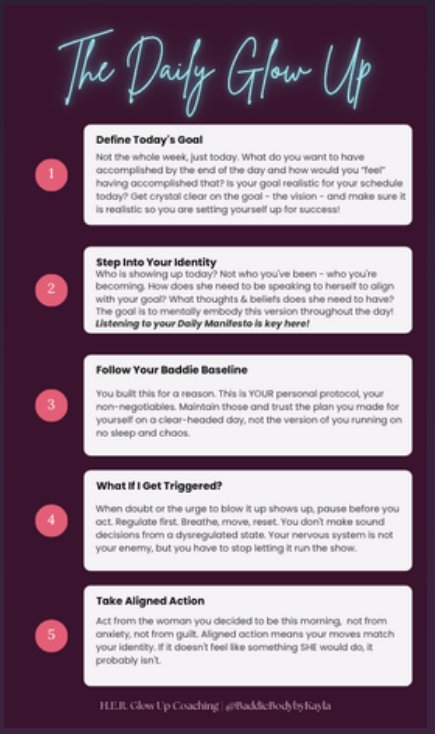
Your daily framework.
Use this in-depth, highly customizable meal planning prompt to stop guessing and start eating like HER.
Get the prompt here.Print them. Fill them out. Use them.
Grab them here.